

Blog

Field notes on vibe coding: how the tools actually behave, where they help, where they bite, and what to check before you ship.

  • [object Object] · News

    How AI coding tools handle context window limits

    Every AI coding tool is really a context manager with a model attached. How selection, indexing and compaction work inside Cursor, Claude Code, Copilot and Codex, and why a million-token window did not end the problem.


  • [object Object] · News

    How to evaluate AI coding tools for your team

    Feature lists and demos tell you almost nothing about how a tool will behave in your codebase. Here is how to run a real evaluation: one live work item, your own review rules, and outcome measures rather than task counts.

  • [object Object] · Risks

    What AI slop is, and how to keep it out of your code

    AI slop is generated output that reads as competent and carries nothing. In a codebase it compiles, passes the happy path, and quietly costs you your architecture. Here is how to recognise it and keep it out.

  • [object Object] · Business

    Who really owns the code an AI writes for you?

    Every major AI coding vendor assigns you the output, and that is the easy half of the question. The harder half is whether prompted code is copyrightable at all, and what a thin authorship record costs you later.

  • [object Object] · Risks

    Security risks of vibe-coded apps and how to fix them

    Measured studies agree on where vibe-coded apps fail: missing authorisation, leaked credentials and baseline defences nobody asked for. Here is the evidence, and the controls that cut the exposure before real users arrive.

  • [object Object] · Best practices

    When to stop vibe coding and take the wheel yourself

    Vibe coding was defined as a way of working for throwaway projects, and most people keep going well past that point. Five signals that it is time to read the code yourself, the security evidence behind them, and how to take over without losing the pace you gained.

  • [object Object] · Best practices

    Testing AI-generated code without writing every test

    You do not have to hand-write every test for AI-generated code, but the checks have to come from somewhere other than the model that wrote it. Spec-first prompting, property-based tests and mutation testing, with the published data behind each.

  • [object Object] · Best practices

    Guardrails that stop an AI agent breaking your app

    An agent obeys its permissions, not your instructions. The layers that actually hold in production: scoped credentials, separated environments, approval gates on destructive actions, spend and time limits, and logs you can reconstruct.

  • [object Object] · Best practices

    Small iterations beat big rewrites in vibe coding

    Asking a model for one verifiable change at a time produces code you can merge; asking for a rewrite produces a pull request nobody can review. The evidence, the mechanism behind it, and the narrow cases where a rewrite is still the cheaper move.

  • [object Object] · Risks

    Why AI coding tools invent APIs that do not exist

    AI coding tools invent functions, parameters and whole packages because they predict plausible text rather than looking anything up. Here is the evidence on how often it happens, why the invented names are convincing, and the checks that catch them before they reach production.

  • [object Object] · Tools

    When to use an agentic coding tool, not autocomplete

    Two questions decide it: does the change touch more than the file you are in, and can something other than your own reading confirm it worked. Here is how the two modes differ, what each is good at, and where an agent is the wrong call.

  • [object Object] · Guides

    Is vibe coding the same as no-code? Short answer, no

    Both let you build software without typing the implementation, but one hands you visual logic you can edit and the other hands you generated source code. What separates no-code from vibe coding, and which failure mode you would rather own.

  • [object Object] · Business

    What your AI code policy must say on security and IP

    Most businesses running AI coding tools have no written rules for them. Here is what a short, enforceable policy has to cover on ownership, review thresholds, dependencies and shadow AI, and which parts belong in CI rather than in a document.

  • [object Object] · Best practices

    Reading the diff is the review vibe coding lacks

    Vibe coding drops the diff read by definition. New formal-verification work shows the same model that writes a vulnerable line spots it 78.7% of the time when asked to review, which is the strongest argument yet for putting the review step back.

  • [object Object] · Best practices

    Reading the diff is the habit vibe coding needs

    Vibe coding, as originally described, meant accepting changes without reading them. The measured cost of that habit is now visible in code quality data and in a string of data leaks. Here is how to read a diff you did not write, and how to keep diffs small enough to read.

  • [object Object] · Guides

    Vibe coding is not no-code, and the gap matters

    Both skip hand-written code, but only one hands you source files you own and have to maintain. Where no-code and vibe coding actually split, what each costs, and how to pick for a specific piece of work.

  • [object Object] · Best practices

    How to write a clear prompt for an AI coding tool

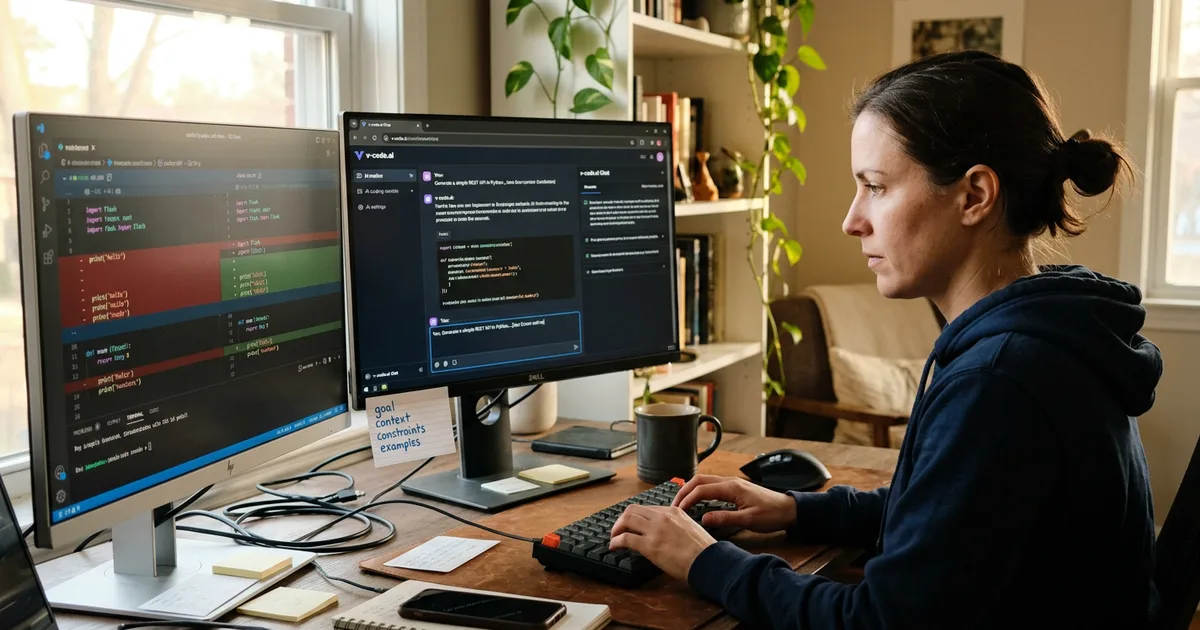
    A prompt that works states the goal in one sentence, carries the context the tool cannot see, names the constraints, and shows one example. Here is the structure, the published guidance behind it, and where prompt quality stops helping.

RSS feed