
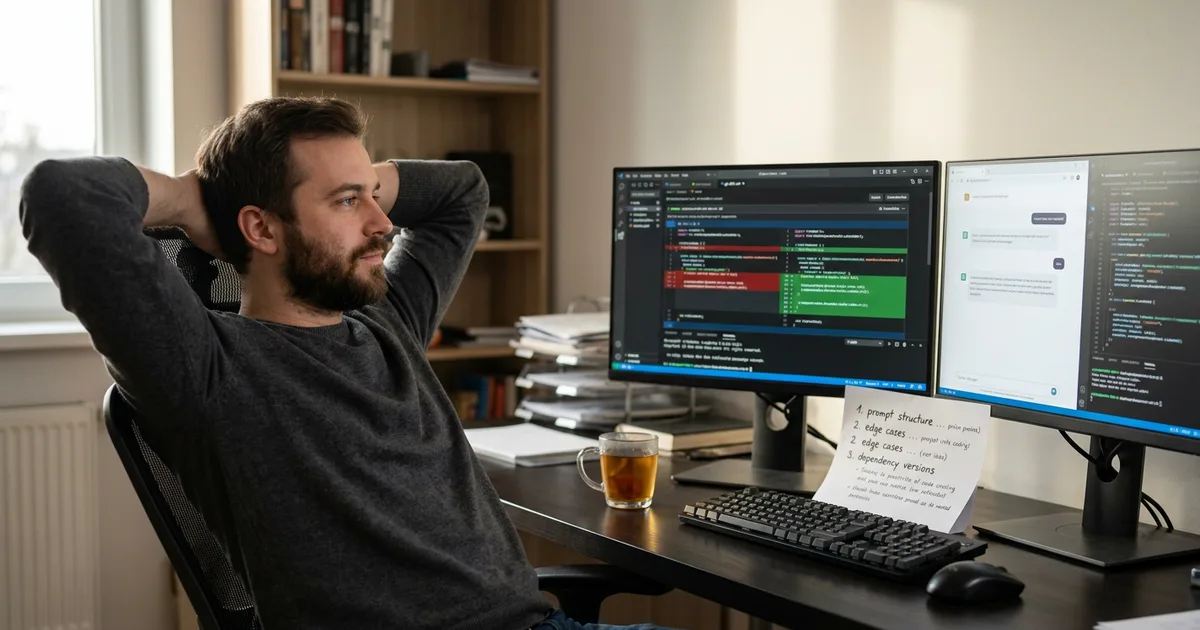
Stop vibe coding the moment the code starts holding something you cannot afford to lose: real users, real data or real money. In day-to-day terms the crossing point shows up as five signals: debugging starts taking longer than building, the app begins storing information that belongs to someone else, you can no longer say what a file does without asking the model, the same defect keeps returning in a new shape, and a second person needs to work in the code. Taking the wheel does not mean closing the tools. It means moving from accepting output to reading it and deciding.
What Karpathy described, and how far the term moved
Andrej Karpathy named vibe coding. The post was descriptive. It was never a method statement.
Adoption has kept climbing. So the interesting question is no longer whether to use these tools; nearly everyone does. It is when to change how you use them, because the way of working that got a prototype running is not the way of working that keeps it alive.
Taking the wheel is not putting the tools down
The original definition rests on one specific omission: not reading the diff. That single act is what separates vibe coding from ordinary AI-assisted development, and it is the switch you are flipping when you take over. You can keep the model generating every line. What changes is that you read what came back, form a view, and either accept it or reject it. We have written separately on why the diff read is the review vibe coding drops by definition, and on the difference between an agentic tool doing multi-file work and an inline assistant finishing a line you already had in mind.
This also explains why the same workflow carries different risk for different people. A developer who can read the generated code can audit it, argue with it and fix it. Someone who cannot read it has no way to tell a working app from an app that happens to work today. The speed looks identical from the outside. The exposure is not remotely the same.
Five signals that the project has moved past prompt-and-accept
The checklists published on this question converge on much the same handful of signals, and they are worth stating concretely rather than as principles.
Debugging starts taking longer than building
This is the signal most sources name first, and it is the easiest to measure honestly: track how much of a session went into getting something new working and how much went into chasing something that used to work. Early on the ratio is flattering. Past a certain size it inverts, and you find yourself in a loop where each fix prompt produces a change that breaks something two files away. A2 Design’s account of moving from vibe coding to engineering covers this same shift.
The trade-off here is real and worth naming. Prompt-and-accept gets you to a running thing faster than hand-writing it. It gets you to a changeable thing more slowly, because nobody has built a mental model of the system on the way.
The app starts holding data that belongs to someone else
A weekend project that stores nothing is a safe place to be careless. The moment there is a login, a payment, an upload or an email address in a table, the risk has moved off your machine and onto other people. This is a step change, not a gradient. If the thing now holds personal data, you are subject to obligations you cannot prompt your way out of, and the code that enforces access control is exactly the code that most needs reading.
You cannot describe what a file does without asking the model
A good test before shipping: open three files at random and say out loud what each one is responsible for. If you cannot, you do not own the codebase, you are renting it from a model that will not remember the conversation. One engineer’s summary of the problem sticks: the generated solution worked, but when it needed optimising for performance, there was nothing to optimise from, because you cannot improve what you do not understand.
The same defect keeps coming back wearing a different shape
A bug that returns three times in slightly different clothes is not a bug. It is a design problem that the fix prompts keep papering over, usually because the same piece of state or the same assumption is being handled in three places. This is where a rewrite of a small area beats another round of patching, and where our note on why small iterations beat big rewrites needs its exception read carefully: the argument is for small scope, not for never restructuring.
A second person needs to work in the code
One person holding a loose model of a system in their head is workable. Two people cannot share a model that was never written down. The Vibe Coder Blog’s warning signs for bringing in a developer land on the same conclusion: the handover cost is what forces the transition, and it is paid whether or not you prepared for it.
What the security evidence adds to the decision
The case for taking the wheel before anything reaches production is where the security evidence is strongest, and it points the same way from several directions: AI-generated code has repeatedly been found to carry security flaws such as injection, hardcoded secrets and broken authentication.
Audits of finished applications tend to be bleaker than audits of snippets, turning up missing protections like CSRF and SSRF defenses and exposed secrets or personal data across the applications reviewed. Methodologies differ, so the headline percentages vary depending on what was scanned and how. Treat the exact numbers as directional. The pattern is consistent in every source: vulnerability prevalence in generated code is high, and it is higher in generated code nobody read.
A further pattern changes how you should read your own confid
Written with AI assistance and reviewed under our editorial policy. Vibe coding changes quickly; details reflect sources current on 2026-09-22. Some passages are the author's opinion. Spotted an error? tell us.
Frequently asked questions
- Does taking the wheel mean I should stop using AI coding tools?
- No. The change is in what you do with the output, not whether you generate it. You can keep prompting for every line, as long as you read the diff, understand the change and take responsibility for accepting it.
- Is vibe coding ever appropriate for production software?
- Karpathy, who coined the term, has said publicly that it suits throwaway weekend projects rather than production systems with users and data. Security audits of finished AI-built applications support that limit, with high rates of missing access control and exposed secrets. Generated code can go to production; unreviewed generated code is the part that should not.
- What if I cannot read code at all?
- Then you cannot audit what the model produced, which is the single biggest difference in risk between a developer and a non-programmer using the same tool. The options are to learn enough to read the security-sensitive parts, bring in someone who can review them, or choose an approach where the logic stays editable by you, which is the argument in our comparison of vibe coding and no-code.
- How do I tell whether a prototype is worth converting rather than rebuilding?
- Look at how much of it you can explain and how much of it you keep patching. If the structure makes sense to you and the recurring bugs are localised, converting it is usually cheaper. If the same defect returns in several places and no file has a clear responsibility, a rewrite of that area with proper review will take less time than another round of fix prompts.